
Why School Fees are More Than Just Money: Tackling the Fee Collection Crisis in Indian K–12 Schools
Introduction
For most Indian schools, collecting fees is far more than a transaction — it's a core challenge with ripple effects on cash flow, teacher morale, parent relationships, and even learning outcomes. Despite India's education sector being one of the world's largest and fastest growing, many institutions still rely on outdated and manual fee collection processes that fail to meet the needs of modern school communities.
Fees Are a Real Challenge — Not Just an Administrative Task
A major survey covering budget private schools across India found that over 87% of these schools reported significant challenges in fee collection. For many, this stems from cash-based systems, scattered records, and delayed payments that disrupt cash flow and planning.
Another study indicates that about 62% of schools struggle to effectively track and record fee payments, undermining financial predictability and creating administrative chaos.
Meanwhile, nearly 40% of Indian parents reported difficulty paying school fees following the COVID-19 pandemic — a trend that highlights broader economic pressures on families and the limitations of manual payment systems.
These are not isolated blips — they show a structural problem in the way fee collection is handled in many schools.
What Happens When Fee Collection Breaks Down?
When fees aren't collected efficiently and transparently:
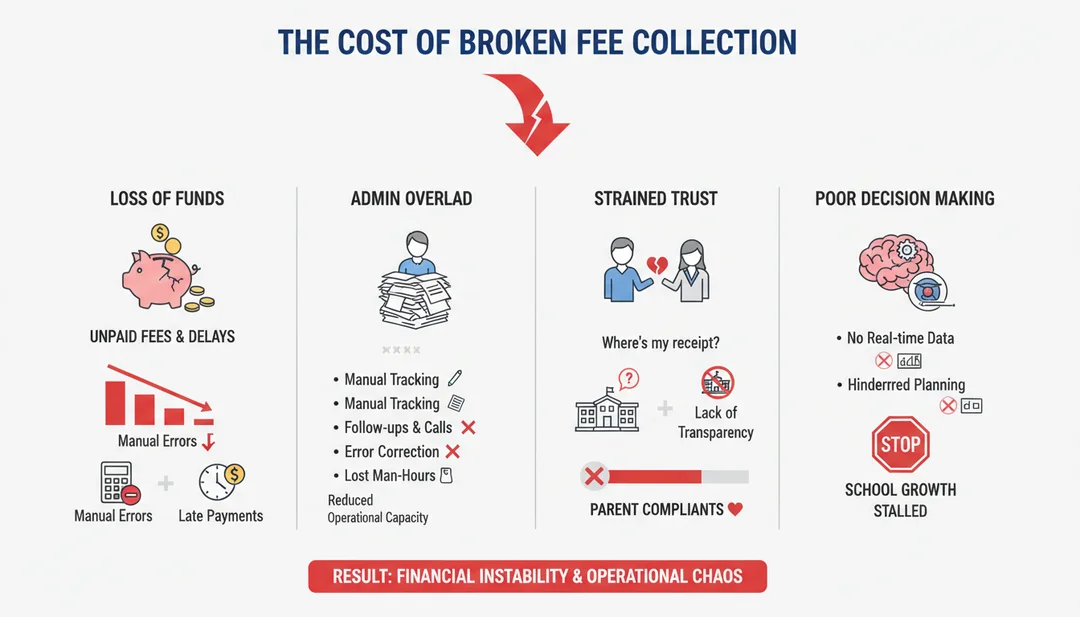
Schools Lose Financial Stability
Schools need reliable cash flow to pay teachers, maintain infrastructure, and plan resources. Delays and errors in fee collection directly reduce their ability to operate effectively.
Administrative Burden Increases
Manual tracking, follow-ups, reconciliations, and error corrections consume significant administrative time, reducing capacity for more important educational work.
Parent–School Trust is Strained
Lack of transparent fee records, unclear payment histories, and late-payment stress erode trust. Parents often ask: "If we are paying fees, why can't we see real-time records of what's due?"
Decision Making Gets Harder
Without accurate, real-time fee data, principals and administrators cannot plan budgets, anticipate defaults, or manage resources intelligently.
Modern Life Exposes Old Problems
India's education sector is rapidly modernizing, with projections estimating the industry to reach ₹26 lakh crore+ by 2030 — and K–12 forming a core part of that growth. Digital technologies, including AI, are being woven into education policy and practice.
But if fee collection remains manual — or partly digital but fragmented — schools, parents, and teachers all lose out:
- Parents want convenience, transparency, and flexibility.
- Administrative staff are overloaded with paperwork.
- Principals lack a clear picture of financial health.
- Students can be unfairly caught in disputes over payments.
Some fee regulation efforts have shifted online — for example, Gujarat has introduced an online affidavit process for school fee declaration to enhance transparency and streamline compliance with fee rules.
Yet these efforts only cover regulation, not the end-to-end fee ecosystem.
The Modern Solution: Unified Digital Fee Management
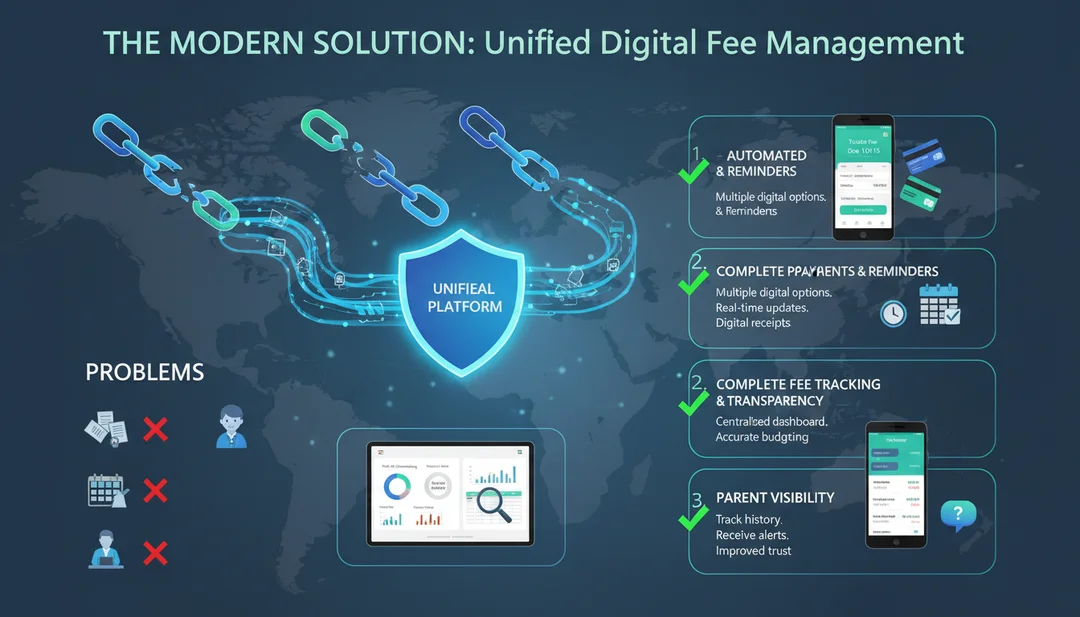
The problems above have a shared root: fragmented fee systems.
A unified digital fee collection platform — integrated into a school's broader operations system — can transform this process in several ways:
Automated Payments & Reminders
Parents get multiple digital payment options and automated reminders, drastically reducing late or missed payments. With real-time updates of balances and digital receipts, the system eliminates manual entry errors.
Complete Fee Tracking & Transparency
A centralized dashboard gives administrators a clear view of:
- Paid vs outstanding fees
- Expected versus actual cash flow
- Parent communication history
This supports accurate budgeting, financial planning, and compliance.
Parent Visibility Reduces Friction
Parents can:
- Track fee history
- View deadlines
- Receive alerts
- Query issues directly through the platform
This improves trust and reduces unnecessary disputes.
Real Benefits for Every Stakeholder
- School Owners & Principals — Reliable cash flow, better financial planning, fewer disputes
- Teachers & Admin Staff — Less manual work, faster reconciliation, more focus on students
- Parents — Easier payments, transparent records, fewer misunderstandings
- Students — Less stress over financial disputes, smoother educational experience
Why Unified Platforms Matter in the Digital Age
Fee collection is not just a financial process — it reflects the health of a school's operations. When fee management is manual or scattered across systems, the entire school ecosystem is affected.
A unified platform does more than automate:
- Integrates fee data with attendance, performance, and communication systems
- Supports policy compliance and reporting
- Enables data-driven decisions and forecasting
- Reduces clerical workload and improves accuracy
In an era where parents expect digital conveniences in every part of life, schools that modernize their fee systems benefit from better engagement, stronger trust, and smoother workflows.
Conclusion: Modern Fee Systems Are No Longer Optional
Fee collection is a vital school function — one that impacts trust, cash flow, administration, and relationships. With large numbers of schools reporting fee collection problems — especially in the private and budget segments — modern, unified digital fee management systems are not a luxury, they are a necessity.
Technology, when implemented thoughtfully, can break the cycle of manual hassles, late payments, and disputes, making school life easier for administrators, teachers, parents, and ultimately students.