
The Indian K-12 School at a Turning Point: From Administration to Intelligence
Introduction
India's K-12 education system stands at a pivotal moment. With over 80,000 schools across major boards and nearly 250 million students, it is one of the largest and most complex education ecosystems in the world. For decades, schools have carried the responsibility of scale using largely manual processes, limited digital infrastructure, and deeply ingrained teaching practices.
Today, a convergence of government policy, parent expectations, and technological maturity is quietly reshaping what schools are expected to be — not just places of instruction, but intelligent institutions capable of adapting, learning, and improving continuously.
This transformation is not uniform. Schools across India are at different stages of digital maturity, and understanding these stages is key to understanding where education is headed next.
The Digital Maturity Journey of Indian Schools
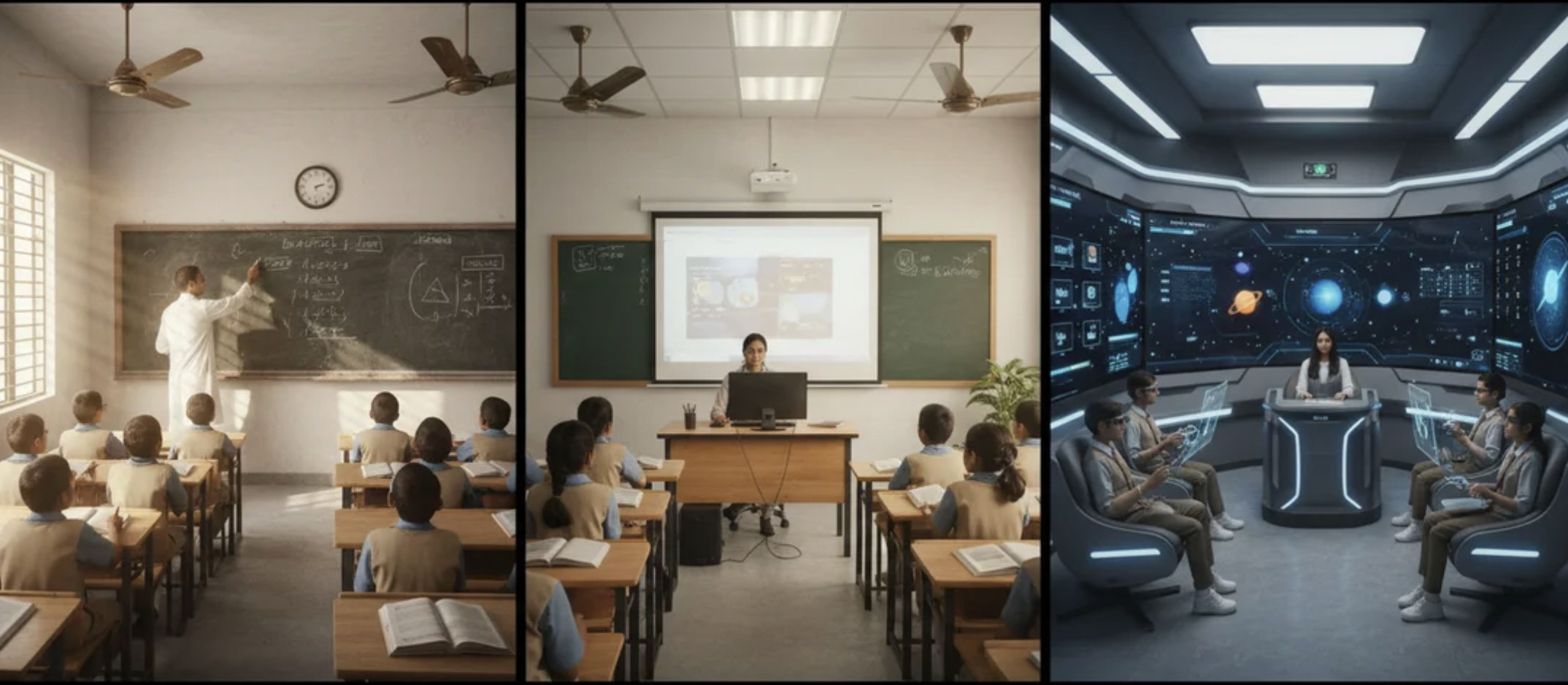
Most Indian schools did not become digital by design — they became digital by necessity.
In many Tier-2, Tier-3, and semi-urban regions, schools still operate in a largely traditional mode. Attendance registers, paper exams, manual fee records, and fragmented communication channels dominate daily operations. Teachers spend a disproportionate amount of time on administrative tasks, leaving less room for pedagogy, mentoring, or innovation.
The next stage of evolution has been digitization, not intelligence. Schools introduced smart boards, digital content, WhatsApp communication, and basic school management software. While helpful, these tools often function in silos. Data exists, but it does not flow. Decisions are still reactive rather than informed.
More mature schools — typically urban private institutions — have moved toward integrated digital platforms. Academic management systems, parent portals, assessment tools, and dashboards bring visibility into performance and operations. Yet even here, the burden on teachers remains high, and insights often arrive too late to meaningfully intervene.
The future lies in the next stage: AI-enabled, intelligent schools — where systems don't just store data but actively support decision-making, teaching, and learning.
Why the Shift Is Inevitable: Policy, Parents, and Pressure
This evolution is not happening in isolation.
Government Policy as a Catalyst
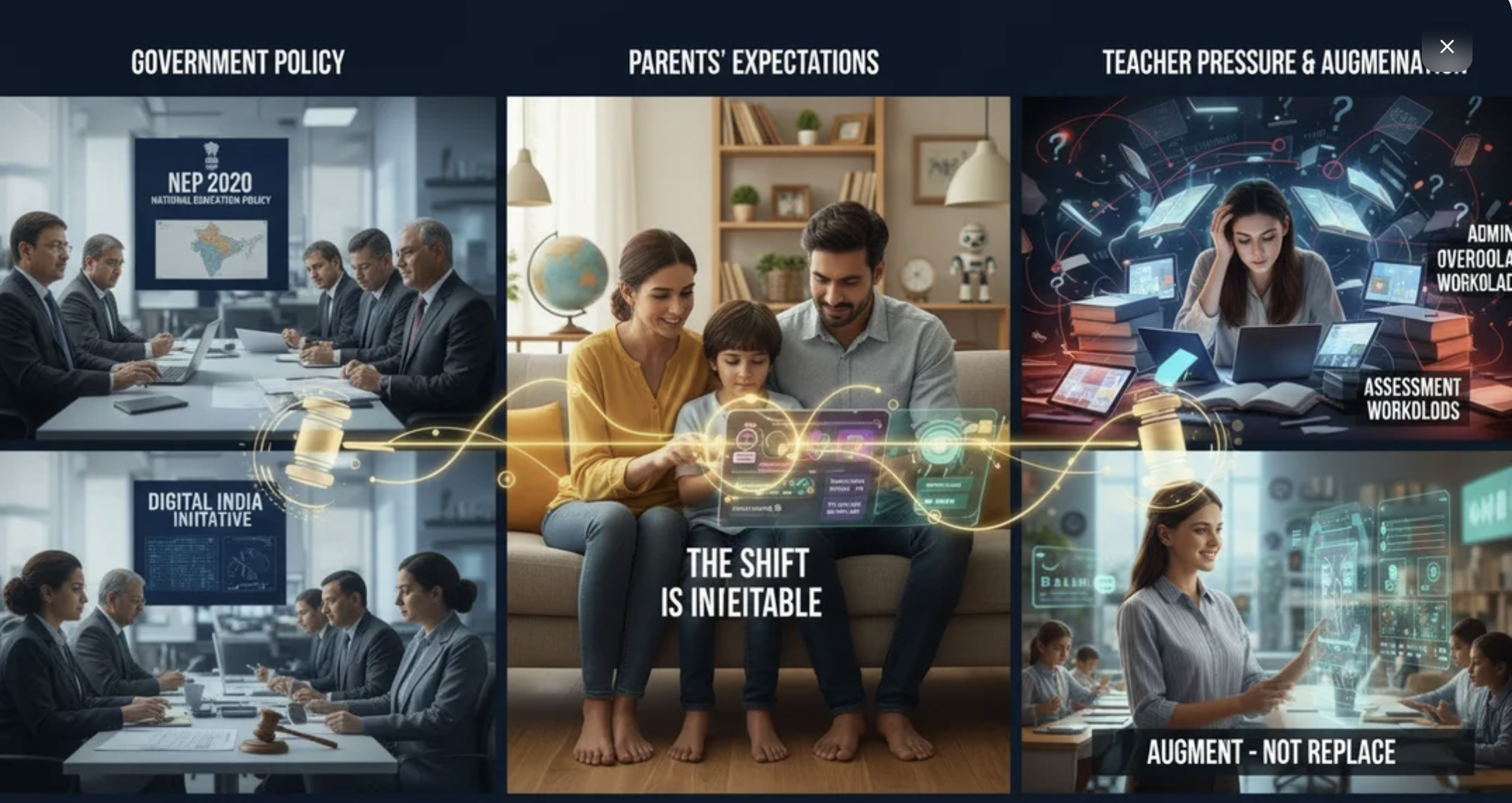
The National Education Policy (NEP) 2020 makes it clear: technology is no longer optional. NEP emphasizes competency-based learning, continuous assessment, personalized instruction, and the ethical use of AI in education. Government platforms like ePathshala, DIKSHA, Saransh, and Shala Darpan reflect a broader push toward data-driven governance and digital access.
Digitally mature schools align more easily with these frameworks, face less friction in compliance and reporting, and are better positioned for government partnerships, grants, and CSR-funded programs.
Parents Are No Longer Passive
Parents today expect far more than syllabus completion. They want:
- Transparency into academic progress
- Early identification of learning gaps
- Skills that prepare students for a rapidly changing world
Periodic report cards are no longer enough. Schools are expected to communicate continuously, explain outcomes clearly, and demonstrate value beyond exams.
Teachers Are Under Pressure
Teacher burnout is a real and growing issue. Administrative overload, assessment workloads, and rising expectations without proportional support are unsustainable. Any future-ready school must address this reality — not by replacing teachers, but by augmenting them.
How Schools Become Smarter — Not Just Digital
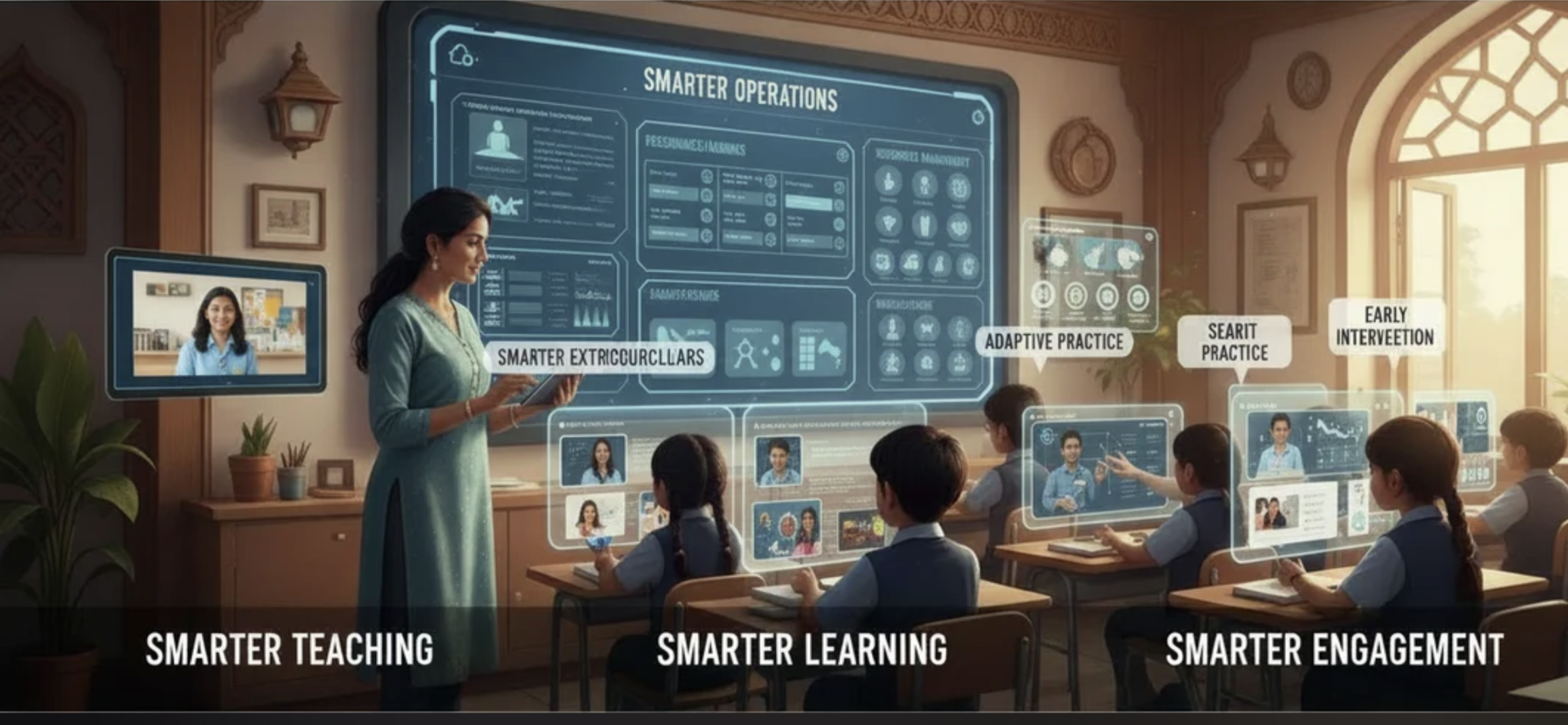
A smart school is not defined by devices or dashboards. It is defined by how effectively it uses intelligence to improve outcomes.
Smarter Operations
Unified digital systems reduce duplication, errors, and dependency on individuals. Real-time dashboards give school leadership clarity on attendance, performance, finances, and compliance — enabling proactive rather than reactive management.
Smarter Teaching
Generative AI can act as a teaching assistant:
- Creating lesson plans aligned to curriculum
- Generating assessments and worksheets in minutes
- Supporting evaluation of written answers with teacher oversight
This saves time, reduces burnout, and allows teachers to focus on what matters most: student understanding and engagement.
Smarter Learning
AI-driven insights enable:
- Continuous assessment instead of one-time exams
- Personalized practice based on student weaknesses
- Early intervention before learning gaps widen
For a country as diverse as India — linguistically, academically, and economically — this adaptability is critical.
Smarter Engagement
Transparent, real-time communication builds trust with parents and strengthens the school's reputation. When parents see clarity and consistency, friction reduces and partnership improves.
The Role of Generative AI in India's Context
India's education challenge is not lack of intent — it is scale and diversity.
Generative AI is uniquely suited to this challenge:
- It scales teacher support without scaling cost
- It adapts content across languages and learning levels
- It brings quality learning experiences to resource-constrained schools
- It enables consistency without enforcing rigidity
Used responsibly, AI becomes the bridge between policy intent and classroom reality.
A Shared Win for All Stakeholders
When schools evolve intelligently:
- School owners gain efficiency, scalability, and credibility
- Teachers regain time and professional satisfaction
- Students receive personalized, engaging learning
- Parents gain trust and visibility
- Government benefits from better data and policy execution
- Society gains future-ready learners
This is not digitization for its own sake. It is institutional intelligence.
Looking Ahead
Indian schools are moving from: Administration-heavy → Digitally assisted → Intelligence-driven
The question is no longer if schools will adopt AI and intelligent systems — but how thoughtfully they will do so.
The schools that succeed will not be those with the most technology, but those that use technology to empower teachers, engage parents, and help every student learn better.
That is the future of K-12 education in India — and it has already begun.